
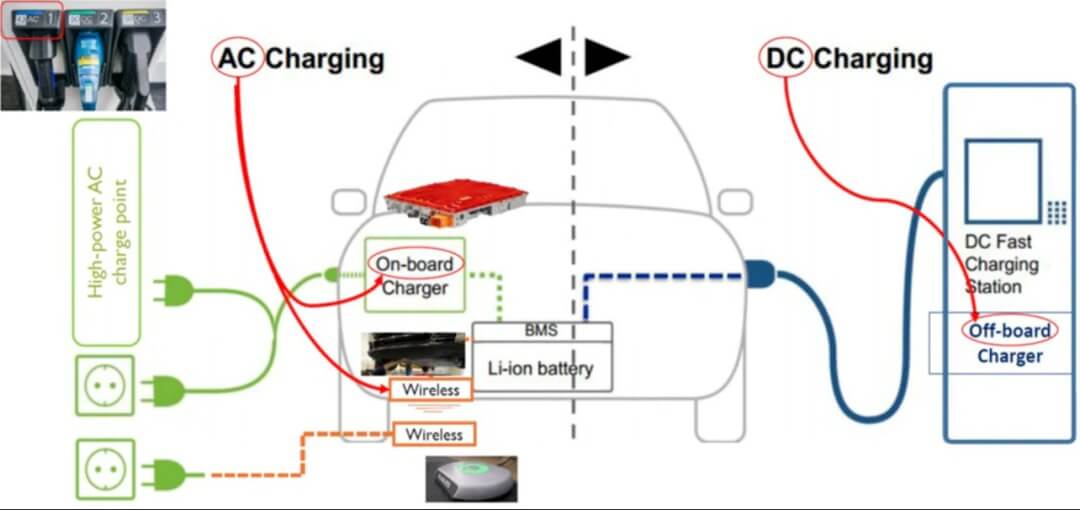
With the rapid development of electric vehicles (إيف), charging technology has become a focus of our’s attention. Among them, شواحن التيار المتردد EV و DC Fast Chargers are the two most common and familiar types. What is the difference between the two and how to choose? This article will deeply analyze the core differences between the two to help us make the right choice.

Charging Principles:
AC chargers (AC charging): The alternating current (تكييف) provided by the power grid is transmitted to the vehicle through the charging pile, and then converted to direct current (العاصمة) by the on-board charger (OBC) and stored in the battery.
Power range: Usually 7-22 كيلوواط, suitable for slow charging at home and in public places.
Charging time: Fully charged takes 4-12 ساعات, depending on the battery capacity and charging power.
DC Fast Chargers (DC fast charging): The charging pile has a built-in converter that directly converts AC to DC, bypassing the on-board charger and directly supplies power to the battery.
Power range: 50 كيلوواط ذلك 350 كيلوواط (some supercharging can reach 1.5 MW), and can be charged to 80% في 30 دقائق.
Charging time: 200 kilometers of range in as fast as 10 دقائق (such as BYD megawatt supercharging)
Use Cases:
| Scenario | AC Charger | شاحن سريع بالتيار المستمرs |
|---|---|---|
| Home/Office | Ideal for overnight charging | Impractical (high grid demand) |
| Long-Distance Travel | Limited range replenishment | Highway rest stops, rapid charging |
| Public Parking | Widely available for daily use | Concentrated in hubs, malls |
Technical Compatibility:
- Connector Types:
- تكييف: Type 1 (US), Type 2 (EU), جيجابايت/ت (الصين).
- العاصمة: احتجاز ثاني أكسيد الكربون (EU/US), تشاديمو (Japan), or Tesla Supercharger.
- Vehicle Limits: Most plug-in hybrids (PHEVs) lack DC fast-charging support.
Pros and Cons Analysis:
AC Charger: Strengths and Limitations
- الايجابيات:
- Affordable, ideal for residential use.
- Gentler on battery longevity.
- سلبيات:
- Slow charging, unsuitable for emergencies.
DC Fast Chargers: Strengths and Limitations
- الايجابيات:
- Ultra-fast charging for long trips.
- Future-proof with high-power support (على سبيل المثال, 350+ كيلوواط).
- سلبيات:
- Frequent use may accelerate battery degradation (~0.1% added wear).
- Higher public charging costs and infrastructure dependency.
How to Choose?
1. Which is better for daily commutes?
Choose AC charging for cost efficiency and battery health.
2. Does DC fast charging harm batteries?
Modern EVs manage heat effectively—occasional use has negligible impact.
3. Will AC chargers become obsolete?
No. AC remains essential for daily needs, while DC evolves toward megawatt speeds (على سبيل المثال, Huawei’s 1.5 MW chargers).