
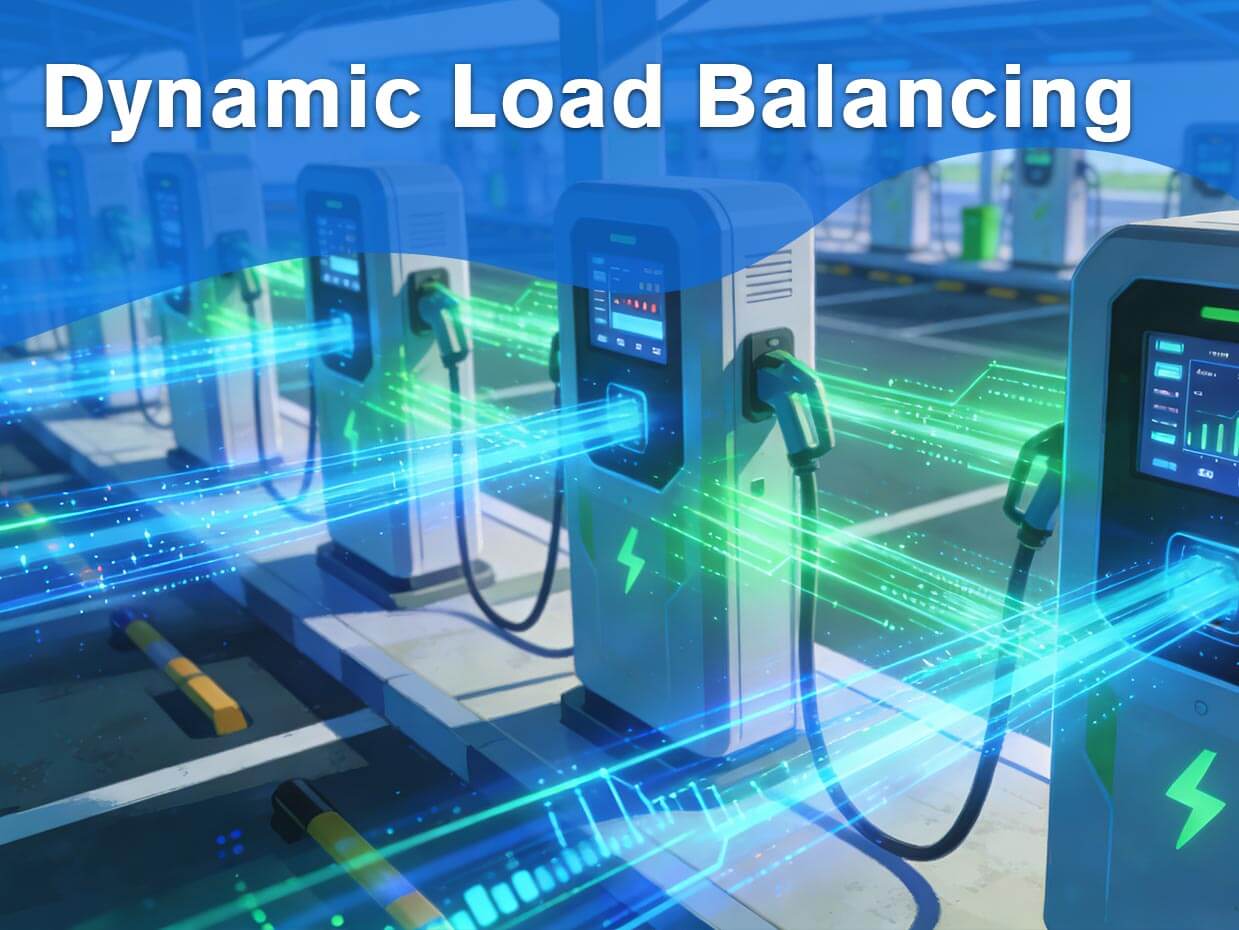
This article will explain what dynamic load balancing is, its necessity, working principle, value, and practical applications.
What is Dynamic Load Balancing?
Dynamic load balancing is an intelligent power distribution management technology. It allows multiple EV chargers in a charging system (such as a home, parking lot, or charging station) to flexibly distribute power based on the real-time available capacity of the power grid. This optimizes charging efficiency and ensures that the total power consumption of all charging devices does not exceed preset safety limits. Its core purpose is to maximize resource utilization without overloading.

To make it easier to understand, sana bir örnek vereyim. Suppose you have a main water pipe in your home. If you turn on the water pipes in the bathroom and kitchen at the same time, the water pressure may drop, and the water flow may slow down. If a smart water valve is installed, it can monitor the total water pressure in real time. When you turn on the branch water pipe in the bathroom, it will automatically adjust the water flow in the kitchen to ensure that the bathroom has sufficient water pressure; when you turn off the branch water pipe in the bathroom, it will redirect all water flow to the kitchen, thereby increasing the water flow rate in the kitchen. The overall goal is to ensure that each outlet can utilize water resources most efficiently when the flow in the main water supply is limited, avoiding situations where no water is available. In an EV charging scenario, the smart water valve represents dynamic load balancing. The main water supply pipe represents the capacity of your home’s electricity meter/transformer, water represents electricity, and the water outlet represents each dynamic load balancing EV charger. Without a smart water valve, it can be understood that the flow rate in each water pipe is fixed, and the flow cannot increase when other water pipes are not in use.
The Necessity of Dynamic Load Balancing

1. Safety: The total power capacity in most locations (such as homes, alışveriş merkezleri, and office parks) is limited. If all EV chargers operate at maximum power simultaneously, it may exceed the capacity of the power distribution system, leading to tripping, equipment damage, and even fire risks.
2. Yeterlik: Static power allocation, where each device has a fixed power, results in wasted resources, as devices cannot charge efficiently at full capacity when idle.
Dynamic Load Balancing EV Charger Working Principle
Core Components: How is it implemented?
1. Current Sensor: Monitors the total incoming current and the power consumption of each device in real time.
2. Central Controller: Runs the load balancing algorithm.
3. Communication Network: Connects each EV charger to the controller.
4. Adjustable Power EV Charger: Dynamically adjusts output power according to instructions.
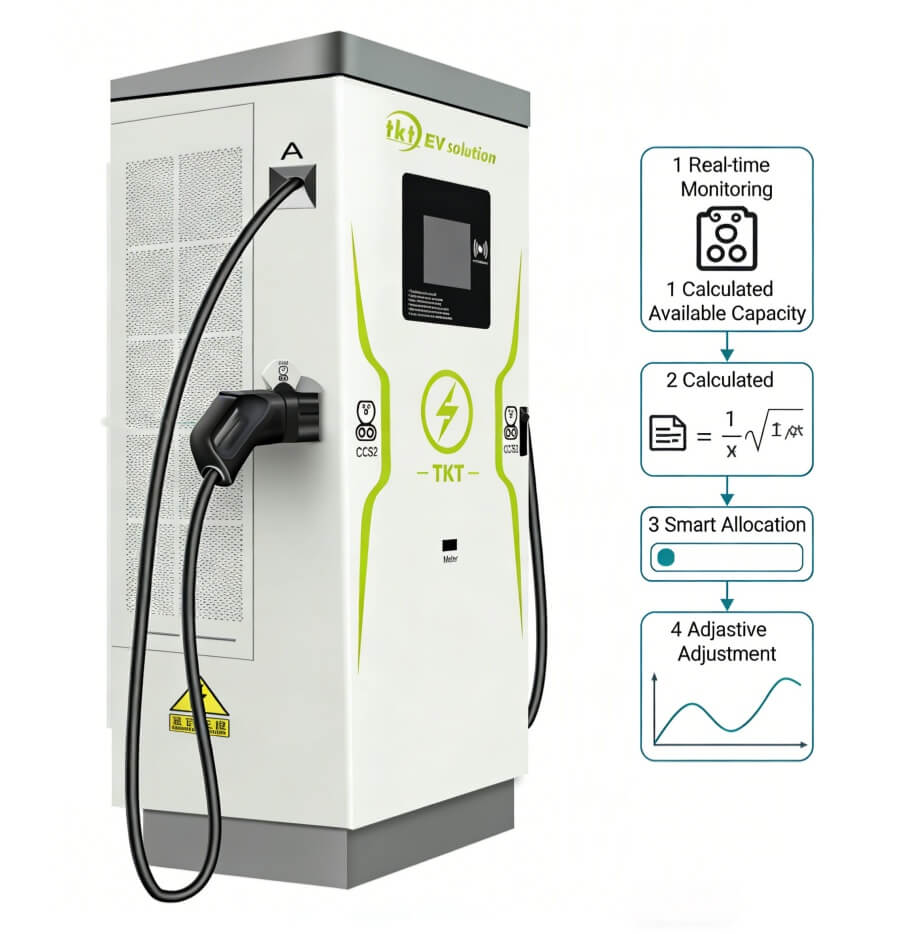
Dynamic Load Balancing Workflow:
1. Real-time Monitoring: The system continuously collects data 24/7 on total power load and the current power, battery level, and charging requests of each EV charger (including chargers and other electrical equipment such as air conditioners and lighting).
2. Calculating Available Power: Based on the set total power limit, other non-charging loads (such as lighting and air conditioning) are subtracted to determine the remaining power available for charging.
3. Intelligent Allocation: If only one vehicle is charging, all available power can be allocated.
If multiple vehicles are charging simultaneously, power is allocated according to a strategy. Common strategies include average allocation, device priority, and remaining battery level.
4. Dynamic Adjustment: When a new vehicle connects, or when a vehicle is fully charged or leaves, the system immediately recalculates and adjusts the power of each EV charging device.
Other Household Electricity Use: If a family member turns on a high-power electric water heater, the system will detect the increase in total load and may temporarily reduce the power of the household charger to ensure that the total load does not exceed the limit and prevent tripping. After the water heater is turned off, the power is automatically returned to the charger.
The Value of Dynamic Load Balancing
1. Stabilizes Grid Operation: By dynamically adjusting charging power, it avoids grid overload, tripping, or overheating caused by multiple charging devices charging simultaneously, alleviating grid pressure and ensuring safety.
2. Saves on Capacity Expansion Costs: For homes, older residential areas, and commercial locations, power capacity is limited. Traditional solutions require applying for increased power capacity from the grid to support multiple high-power DC chargers, which is expensive. Dynamic load balancing utilizes existing power resources for dynamic adjustment, avoiding some capacity expansion needs.
3. Improves Charging Efficiency: Optimizes power allocation, reducing charger idleness or overload, and improving EV charger utilization and turnover rate.
4. Enhances User Experience: Intelligently allocates power based on the user’s vehicle type and remaining battery status, shortening user waiting time.
Dynamic Load Balancing Application Description
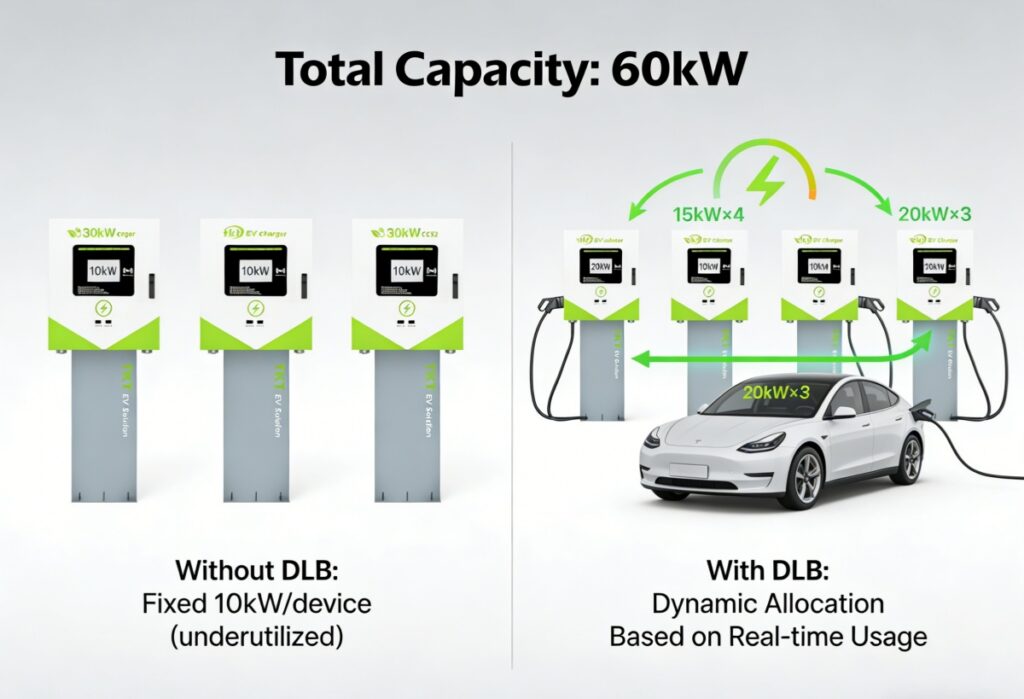
Scenario: A surface parking lot has six 30k DC chargers installed, but the total capacitor only supports 60kW.
Without DLB: If three vehicles are charging simultaneously, the system will directly limit the current to 10kW per device (60/6=10), resulting in slow charging speed.
With DLB: The system detects three vehicles and automatically allocates approximately 20kW to each charging device. If a fourth vehicle joins, the current drops to 15kW per device. Once one vehicle is fully charged, the remaining vehicles automatically resume their previous charging power.
TKT: China's Leading EV Charger Manufacturer
TKT is a Chinese technology company specializing in the R&D, üretme, and sales of chargers for new energy electric vehicles. The company has invested 200 million RMB and has a factory area of 8,200 square meters.
Currently, it has developed a variety of products, including DC chargers, AC chargers, and three-way DC chargers. We have established long-term cooperative relationships with well-known domestic and international companies such as BYD Auto, TATA Motors, and Yutong Bus.
Özet
A dynamic load balancing EV charger is essentially a smart manager. Through real-time monitoring and automated control, it flexibly and efficiently allocates limited power resources, like slicing a cake, to every charging device in need, while ensuring absolute power safety. Kullanıcılar için, this means safety, cost savings, and efficiency; for operators, it means providing maximum service capacity with minimal infrastructure investment.
With the increasing prevalence of electric vehicles and the growing complexity of charging scenarios, dynamic load balancing has become an essential core technology for mid-to-high-end charging solutions, especially in multi-device deployment scenarios.
Product Recommendations:
Yeni DC EV Şarj Cihazları | 60kW-180kW Click to Browse
WallBox DC Şarj Cihazları | 30kW-60kW Click to Browse
Facebook: https://www.facebook.com/TKTHVAC/
LinkedIn: https://www.linkedin.com/company/tkt-hvac
Youtube: https://www.youtube.com/@TKTHVAC